
Battle of Aspern – Essling
May 21st – 22nd, 1809
In 1809, after capturing Vienna during the War of the Fifth Coalition, Napoleon sought to cross the Danube and force the Austrian army into a decisive engagement. Using pontoon bridges from Lobau island, the French established a bridgehead near the villages of Aspern and Essling. Archduke Charles, commanding a superior Austrian force, moved swiftly to attack the French position before Napoleon could bring his full army across.
On May 21, Austrian troops launched assaults on both villages, sparking heavy fighting that lasted throughout the day. Aspern changed hands repeatedly, while Essling became a focal point of the French defense. By evening, Napoleon had reinforced his lines but remained constrained by the fragile bridges, which broke under the river’s strong current and enemy fire.
The following day, Austrian attacks intensified. At Aspern, Charles committed fresh troops, eventually driving the French from most of the village. In Essling, defenders fought desperately around the granary, holding off superior numbers. Napoleon attempted counterattacks, but the broken bridges denied him reinforcements. By nightfall, he ordered a retreat to Lobau. The French lost around 20,000 men, including Marshal Lannes, while Austrian casualties were comparable. The outcome marked Napoleon’s first major defeat and greatly lifted Austrian morale.
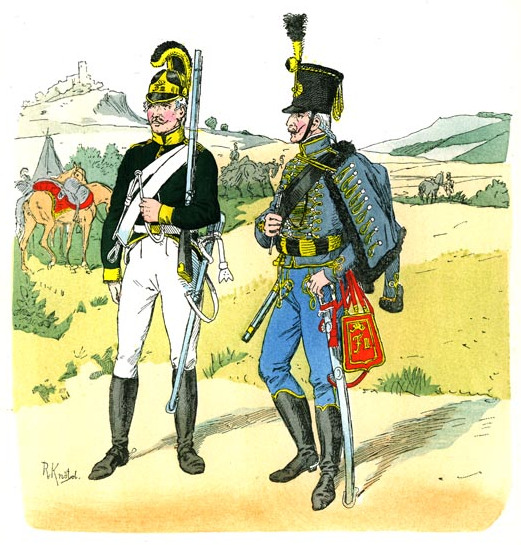
Belligerants
- France (Command 5, Leaders 3, Initiative)
- Austria (Command 5, Leaders 3)
Scale
One Space = ~ 400 meters
One Unit = ~ 4000 infantry / 2000 cavalry / 50 guns
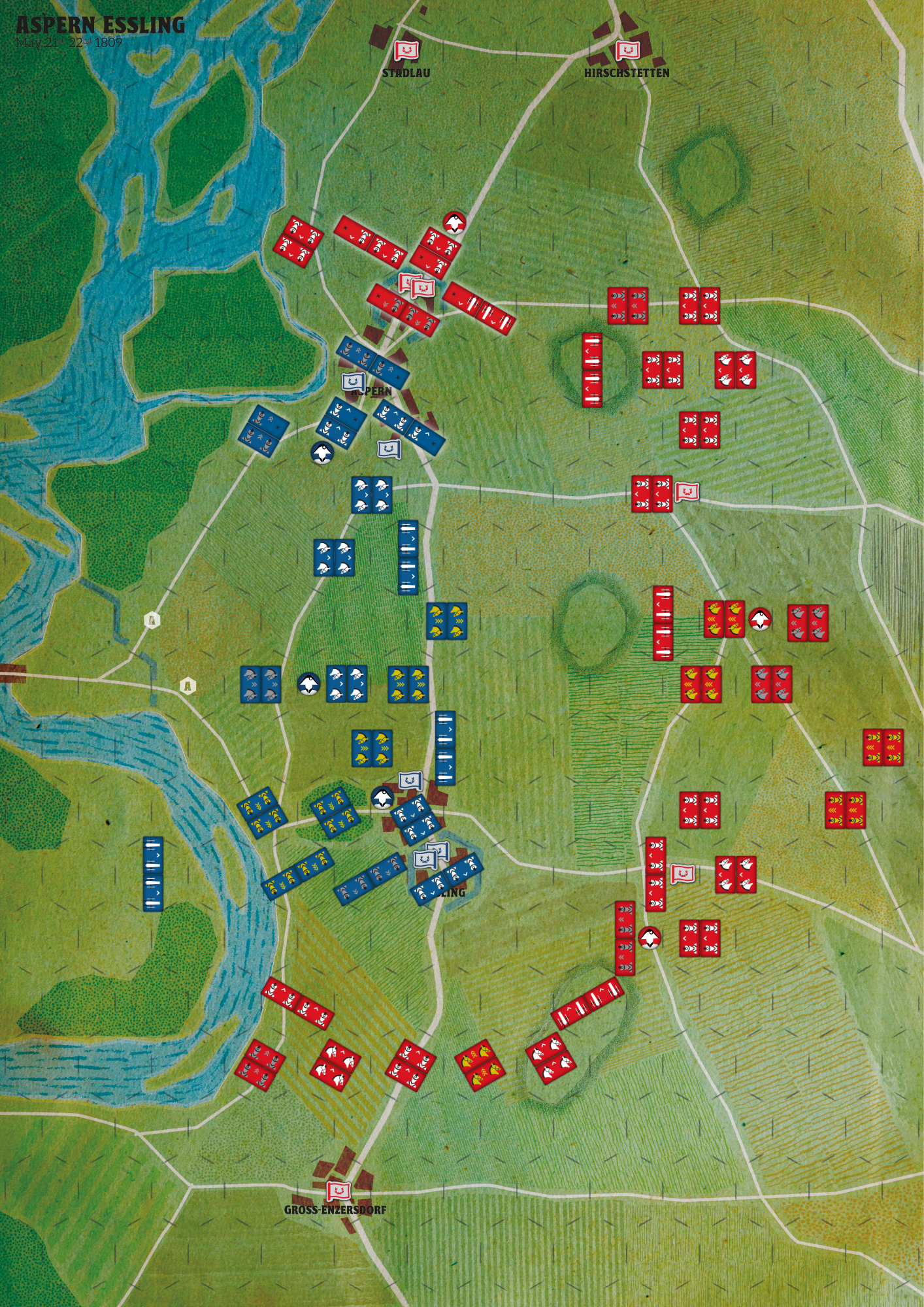
Starting deployment
Special rules
Two-Day Battle – The setup refers to the second day of battle. For this reason, some units start with only three points of strength. The fight had actually started the day before, with Massena’s corps and some cavalry units defending the fragile bridgehead across the Danube.
Pontoons – French reinforcements and supplies depended on the condition of the fragile pontoons hastily constructed on the Danube.
- At the start of the game, place the red marker on the indicated square of the Pontoon track, and the blue one on the first square of the French reinforcement track.
- At the end of their turn, the Austrian player may spend one unused Activation marker to attempt to destroy the pontoon. To do so, they roll a die and move the red marker one space to the left with a roll of 3-4, or two spaces with a roll of 5-6.
- At the end of their turn, the French player can repair the pontoon by spending one or two unused Activation markers to move the marker one space to the right for each marker spent (without rolling the die).
- As the last action of the turn (but not during the Rally turn), the French player advances the blue marker by the number of spaces indicated on the space occupied by the red marker and enters the reinforcements indicated on the spaces reached or passed through, from one of the spaces of the battlefield marked with the letter ‘A’.
- When the Austrian player performs a Rally, the French player obtains the number of VP indicated by the space occupied by the red marker
- If the red marker is on the leftmost box of the track, the French player begins their turn with one less Activation marker available.
Bonaparte – Once per game the French player can decide to place an available Order token on the ‘Coup de Foudre’ (‘lightning strike’) space to distribute the Activation markers as desired and activate units of choice. The Order token placed on the ‘Coup de Foudre’ space is not recovered when a Rally is performed.
Archduke Charles – The Austrian army is led by its most skilled leader, Archduke Charles. Each time the Austrian player performs a Rally, it is as if he had two additional Activation markers (7 instead of 5).
Faq & Errata
There are currently no FAQs or errata for this battlefield.
Alternative rules
The rules for playing both days of the battle are currently being developed.